Major outages and post-mortemsBackground
Starlink global outage on July 24, 2025 lasts about 2.5 hours
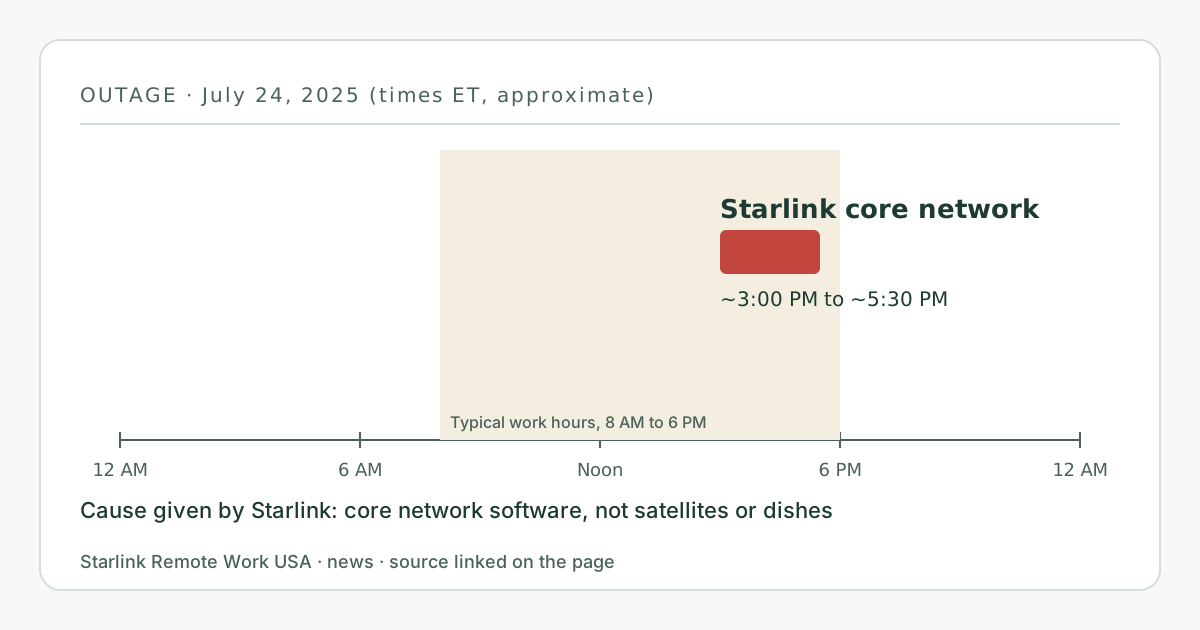
Starting around 3 p.m. ET on July 24, 2025, Starlink customers in the US and many other countries lost service for about 2.5 hours. Starlink’s VP of engineering, Michael Nicolls, said the outage was caused by a failure of key internal software services that operate the core network. Because no setting on the dish helps when the core network fails, a backup line on a different network is the only thing that would have kept a work day going. Published October 6, 2026.
- Event date
- Published here
- Updated
- Source
- Light Reading
Background itemThis happened 439 days before we published it (more than 90). It is here as context for the guides it links, not as breaking news. Check the source for anything that has changed since.
What changed
On Thursday, July 24, 2025, Starlink went down for customers across the US and in many other countries. Light Reading reported that the outage lasted about two and a half hours. User reports on Downdetector peaked around 4 p.m. ET.
Starlink’s VP of engineering, Michael Nicolls, said the outage was due to the “failure of key internal software services that operate the core network.” SpaceX CEO Elon Musk apologized and said SpaceX would fix the root cause so it would not happen again.
This was not a satellite failure, a weather event or a dish problem. It was the ground software that runs the network.
When
- Start: around 3 p.m. ET on July 24, 2025.
- Duration: about 2.5 hours, so service came back for most users around 5:30 p.m. ET.
Who is affected and what it means for you
Every Starlink customer was in the outage area, whatever the plan, dish model or sky view. For remote workers on the East Coast, it took out the last part of the work day. For the Central, Mountain and Pacific time zones, it landed squarely in the afternoon.
The lesson is about backup design, not about Starlink being unreliable in general. A core network failure is the one kind of outage no setting can fix. Restarting the dish, moving it, or switching plans would not have helped. Only a second connection on a different network would have kept a call going: a cellular router or hotspot, a fixed wireless line, or a DSL or cable line if one exists.
Starlink’s business plans include a service level agreement. Starlink’s support pages, as we last checked them, say Local and Global Priority guarantee 99.9% network availability per billing month and credit 20% of the base cost if that is missed. An SLA credit pays a little money back; it does not keep you online.
What you can do now
- Build or check your backup line with the Failover Builder. It asks five questions and suggests a primary line, a backup on a different network, a dual-WAN router and a UPS.
- Test the switch before you need it. Unplug the dish during a quiet hour and see whether your router fails over and your VPN reconnects.
- For offices, our office backup line guide compares satellite and cellular as the standby.
- Decide in advance what work moves to the phone during a long outage: calls, chat, two-factor codes.
- If you’re deciding whether Starlink can be your only line, our remote work verdict covers who shouldn’t rely on it without a backup.
What stays the same
- Starlink’s plans, prices and policies did not change because of the outage.
- Our advice was the same before and after: anyone whose pay depends on calls should have a backup line on a different network.
What we don’t know yet
- Starlink has not published a detailed post-mortem in a place we could find and cite. We know the cause only from the short statement above.
- We don’t know how many customers were affected. Downdetector counts are user reports, not a customer count.
- Our own logger had not started, so we have no minute-by-minute view of this outage.
This item is background: it happened more than 90 days before we published this page.
Source
Software failure triggers nationwide Starlink outage (Light Reading)
Related guides on this site
Correction log
No corrections since publication. Spotted an error? See corrections for how to tell us; changes are logged here with the date.