Major outages and post-mortemsBackground
AWS outage in US-EAST-1 on October 20, 2025 breaks many work apps
From 11:48 p.m. PDT on October 19 to 2:20 p.m. PDT on October 20, 2025, AWS services in its Northern Virginia (US-EAST-1) region failed in stages. AWS’s own summary traces it to a race condition in DynamoDB’s automated DNS management that left an empty DNS record. Apps built on AWS failed for users on every kind of connection, so a backup internet line would not have helped. Published October 6, 2026.
- Event date
- Published here
- Updated
- Source
- AWS
Background itemThis happened 351 days before we published it (more than 90). It is here as context for the guides it links, not as breaking news. Check the source for anything that has changed since.
What changed
On October 20, 2025, Amazon Web Services had one of its largest outages in years, centered on its Northern Virginia region, US-EAST-1. Apps and websites that run on AWS failed or slowed for a large part of the US work day.
AWS’s own summary explains the cause. A latent race condition in the automated system that manages DNS for DynamoDB, AWS’s database service, left the regional DynamoDB endpoint with an empty DNS record, and the automation could not repair it. Other AWS systems depend on DynamoDB, so the failure spread: launching new EC2 servers failed, and Network Load Balancer connections had errors. AWS lists Lambda, container services, Amazon Connect, sign-in services, Redshift and its own support console among the affected services.
AWS said it disabled the DynamoDB DNS automation worldwide while it fixes the bug, and listed further changes to load balancer health checks and EC2 recovery testing.
When
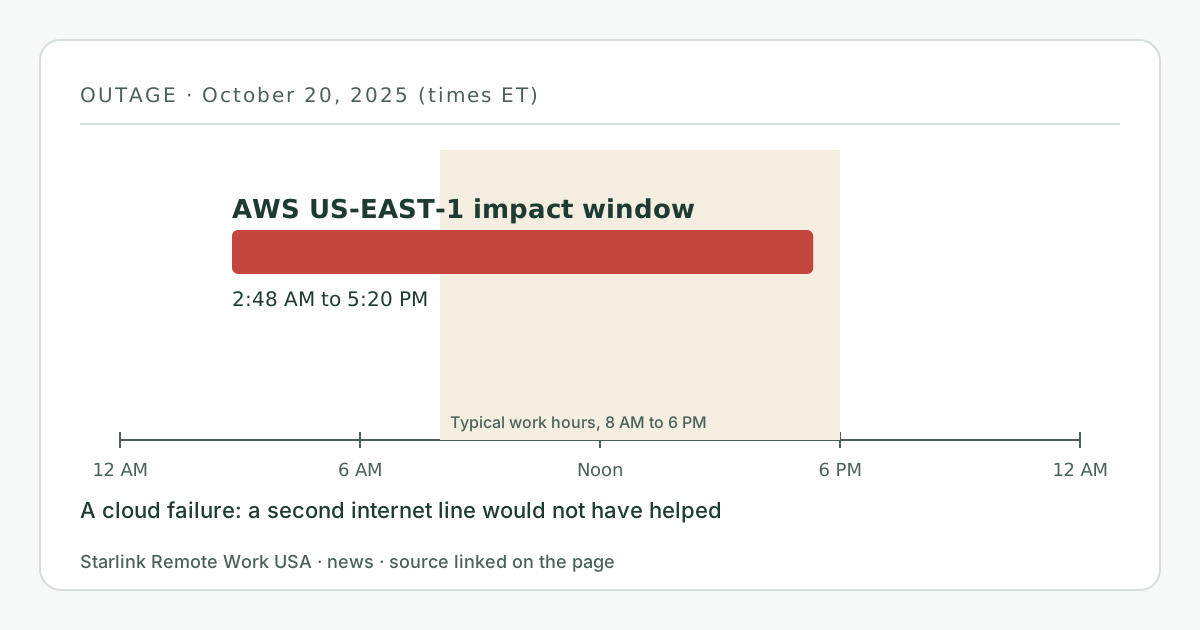
- Impact window: 11:48 p.m. PDT on October 19 to 2:20 p.m. PDT on October 20, 2025.
- In Eastern time: 2:48 a.m. to 5:20 p.m. on October 20.
- AWS describes three overlapping periods: DynamoDB errors first, then failed EC2 launches, then load balancer errors.
Who is affected and what it means for you
Anyone using an app that runs on AWS in that region was affected, on every kind of internet connection. That includes many business tools, call-center software built on Amazon Connect, and consumer apps.
For a remote worker on Starlink, the important point is what didn’t fail: your connection. The dish, the satellites and Starlink’s network were fine. Switching to a backup line would have reached the same broken services, and restarting the router would have changed nothing.
This is the kind of outage to recognize quickly so you don’t spend an hour on the wrong fix. It’s also a reason for businesses not to treat “we have a second internet line” as a full continuity plan. A second line covers your connection. It doesn’t cover the clouds your tools run on.
What you can do now
- When several unrelated apps fail at once, check a cloud status page (the AWS Health Dashboard) and a news source before touching your network.
- Check your own link in the Starlink app. If it shows no outages and normal latency, the problem is upstream.
- For offices, list which tools depend on a single cloud region and what staff should do when one goes down. Our office backup line guide covers the connection half of that plan.
- Our troubleshooting page helps you separate your-side failures (obstructions, CGNAT, Wi-Fi calling) from someone else’s outage.
What stays the same
- Nothing about Starlink changed.
- A backup internet line is still the right fix for failures on your own path.
What we don’t know yet
- AWS’s summary does not give a count of affected customers or end users.
- The AWS summary page does not show a publication date in the copy we read; we date this item by the event.
- We have no logged data from October 2025.
This item is background: it happened more than 90 days before we published this page.
Source
Summary of the Amazon DynamoDB Service Disruption in the Northern Virginia (US-EAST-1) Region (AWS)
Related guides on this site
Correction log
No corrections since publication. Spotted an error? See corrections for how to tell us; changes are logged here with the date.