Major outages and post-mortems
Google Cloud outage in us-west1 on August 20, 2026 traced to planned fiber maintenance
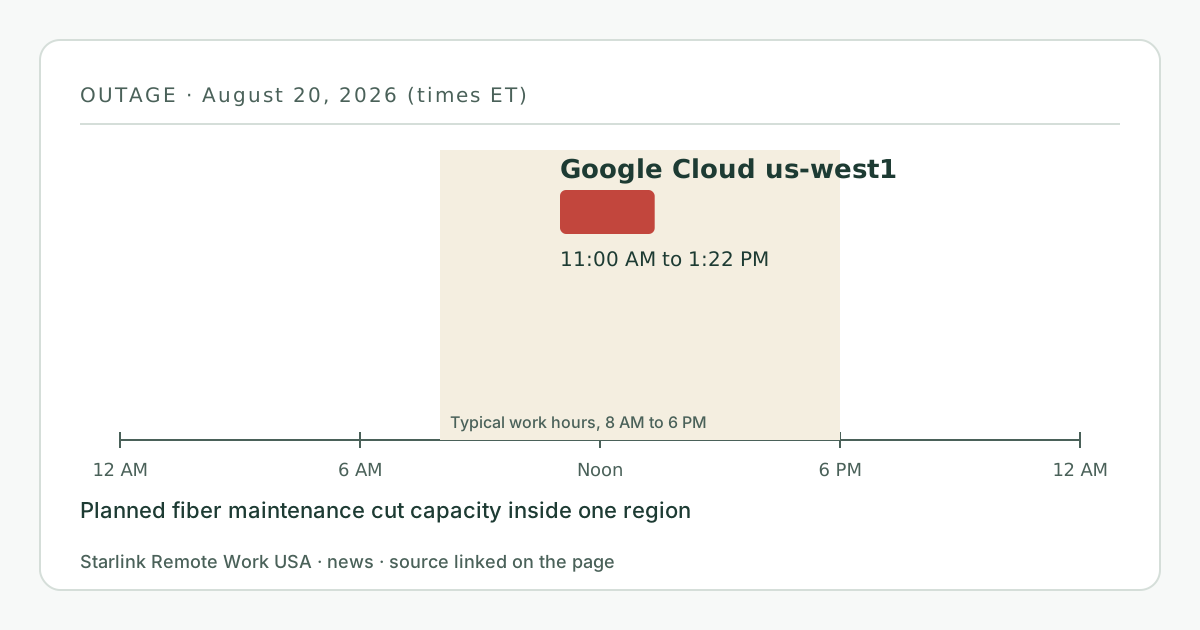
From 08:00 to 10:22 Pacific time on August 20, 2026 (11:00 a.m. to 1:22 p.m. EDT), many Google Cloud services in the us-west1 region in Oregon had elevated latency, errors and failures. Google’s incident report says scheduled fiber optic maintenance unexpectedly cut network capacity between its data centers there and automatic rerouting did not shift traffic properly. Business apps hosted in that region could fail for remote workers even when their home connections were fine. Published October 6, 2026.
- Event date
- Published here
- Updated
- Source
- Google Cloud Service Health incident report
What changed
On the morning of August 20, 2026, Pacific time, Google Cloud’s us-west1 region (The Dalles, Oregon) had a large disruption. Google’s incident report says multiple services there “experienced elevated latency, provisioning failures, increased error rates, and widespread service degradations.” The list of affected products covered core building blocks such as Compute Engine, Kubernetes Engine, Cloud Run, Cloud Storage, Cloud SQL, BigQuery and Identity and Access Management.
Google’s explanation: “The disruption originated during scheduled fiber optic maintenance, which unexpectedly compromised network capacity between data centers within the us-west1 region. Automated rerouting mechanisms failed to properly redistribute traffic to alternate capacity, resulting in network congestion.” That congestion caused “severe packet loss, request throttling, and increased latency” between Google’s own sites, which cascaded into errors for services that depend on them.
When
- Outage: 08:00 to 10:22 PDT on August 20, 2026, 2 hours and 22 minutes (11:00 a.m. to 1:22 p.m. EDT). August 20 was a Thursday.
- Full incident report: posted on August 27, 2026, after a preliminary report on August 25.
Who is affected and what it means for you
You wouldn’t see “Google Cloud” on your screen. You would see a business app, a company portal, a booking system or a file service, hosted in that region, that suddenly timed out or threw errors in the middle of the workday. It looked like a connection problem from home, but it wasn’t: the congestion and packet loss were inside Google’s network, between its data centers.
That is the key lesson for remote workers and small offices. A backup internet line protects your path to the internet. It can’t fix a failure inside the service you are trying to reach. Switching to a hotspot during this outage would have used mobile data and changed nothing.
What you can do now
- When one app fails and others work, check the vendor’s status page or ask IT before touching your router.
- Check your own link in the Starlink app’s statistics. No outages on your side points upstream.
- For a small business: ask your software vendors where they host and whether they can fail over to another region. Our office backup guide covers what a second line does and doesn’t protect.
- Our troubleshooting page helps tell home faults from service faults.
What stays the same
- Starlink and home internet were not involved.
- Google’s incident lists us-west1 (Oregon) and a “Global” location as affected; it doesn’t name other regions.
What we don’t know yet
- Which consumer and business apps were hit. Google lists its own products, not its customers’ apps.
- How many customers were affected. The preliminary report said the proportion of affected projects would come later; the full report we read doesn’t give a number.
Source
Related guides on this site
Correction log
No corrections since publication. Spotted an error? See corrections for how to tell us; changes are logged here with the date.