Business plan changesBackground
Starlink replaces its Priority business plans with Local Priority and Global Priority
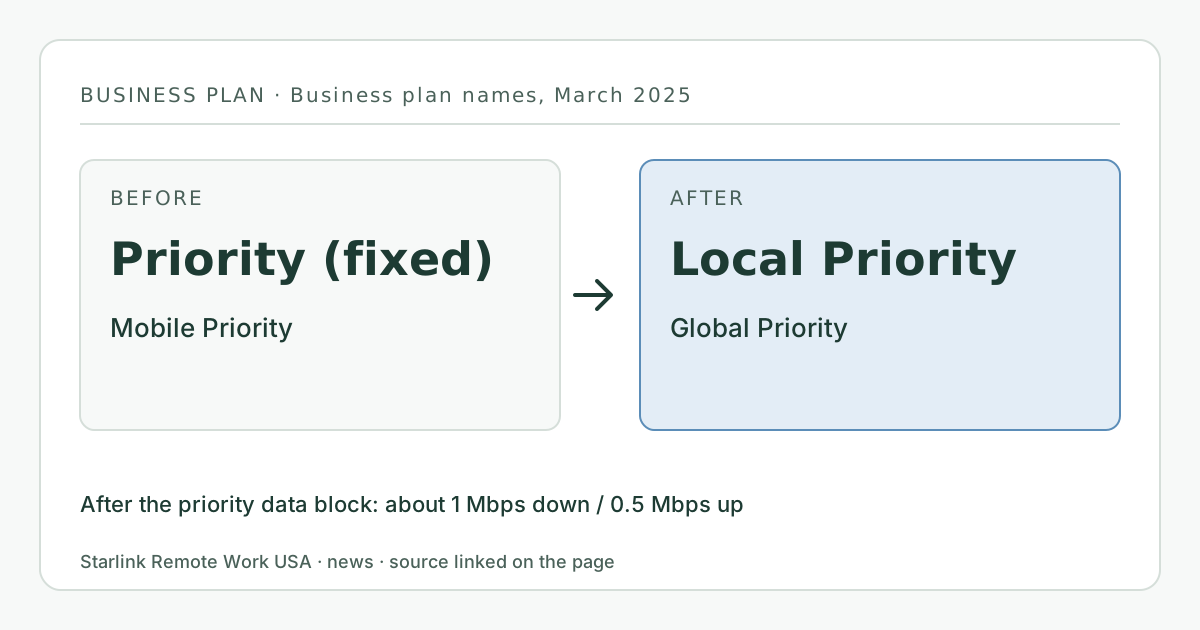
Starlink replaced its fixed-location Priority plan with Local Priority and its Mobile Priority plan with Global Priority, moving existing customers at their next billing period. Priority data became a monthly block; once it is used up, speeds drop to about 1 Mbps down and 500 kbps up unless more is bought. Offices using Starlink as a main or backup line should check which block they are on.
- Event date
- Published here
- Updated
- Source
- Mobile Internet Resource Center
Background itemThis happened 566 days before we published it (more than 90). It is here as context for the guides it links, not as breaking news. Check the source for anything that has changed since.
What changed
In March 2025 Starlink changed how its business plans work. The plan that used to be called Priority, for a fixed address, became Local Priority. The plan called Mobile Priority, for use while moving or across borders, became Global Priority. The Mobile Internet Resource Center reported the change on March 19, 2025, the week it began.
The bigger change was how priority data is sold. As the source’s headline put it, unlimited high-speed data was eliminated: both new plans use a monthly block of priority data. The source reported blocks of 50 GB and 500 GB at the time. Data bought in a month is good for that billing month or until it runs out, and it does not roll over.
When the priority block is used up and you don’t buy more, the line slows to about 1 Mbps down and 500 kbps up for the rest of the month. That is enough for email and a text chat. It isn’t enough for a video call.
When
- Announced: week of March 19, 2025.
- Effective for existing customers: at their next billing period after the change. The source said customers would be moved automatically, Priority to Local Priority and Mobile Priority to Global Priority, with no option to keep the old terms.
Who is affected and what it means for you
This matters to small offices, shops and job sites that run Starlink on a business plan, as the main line or as a backup. It does not change Residential plans.
The data-block model changes how you plan a backup line. A backup that sits unused most of the month barely touches its priority data. A backup that has to carry a full office through a long outage at the main line can burn through a small block quickly. When it does, the line falls to the slow rate in the middle of the outage you bought it for.
For main lines, priority data that runs out at month end means slower afternoons and dropped calls on the last days of the cycle unless someone tops it up.
The Priority plans also still carry the features that matter for remote access. Starlink’s support pages, which we check on a schedule, say a public IPv4 address is an opt-in available only on Local Priority and Global Priority plans. Residential stays behind CGNAT.
What you can do now
- Check which plan and block you are on in your Starlink account. The lineup has changed again since March 2025; our business plan guide lists the current tiers and their checked dates.
- Estimate your monthly priority use. A main office line needs a block that covers a whole month. A backup line needs a block sized for your longest likely outage, not your average month.
- Decide who tops it up. Someone should know how to buy more priority data before the slow lane starts.
- If the line is a backup, read our office backup line guide for how satellite compares with a cellular standby.
- If you need inbound access (a VPN server, a camera system, hosting), our CGNAT and public IP guide explains why only Priority plans offer a public IPv4.
What stays the same
- Residential plans were not part of this change.
- Starlink’s support pages still list public IP as a Priority-only option, and still say Starlink does not offer static IP addresses.
- No contract was added; Starlink’s business terms say there are no contracts or exclusivity requirements.
What we don’t know yet
- Starlink’s announcement email and its support page at the time were not archived by us, so we rely on the Mobile Internet Resource Center’s report for the March 2025 details.
- Prices and block sizes have changed since March 2025. We don’t repeat the 2025 prices here; current ones live on the business guide with the date we checked them.
- We haven’t seen Starlink publish how often business lines reach the slow lane.
This item is background: the change happened more than 90 days before we published this page.
Source
Also cited
Related guides on this site
Correction log
No corrections since publication. Spotted an error? See corrections for how to tell us; changes are logged here with the date.